
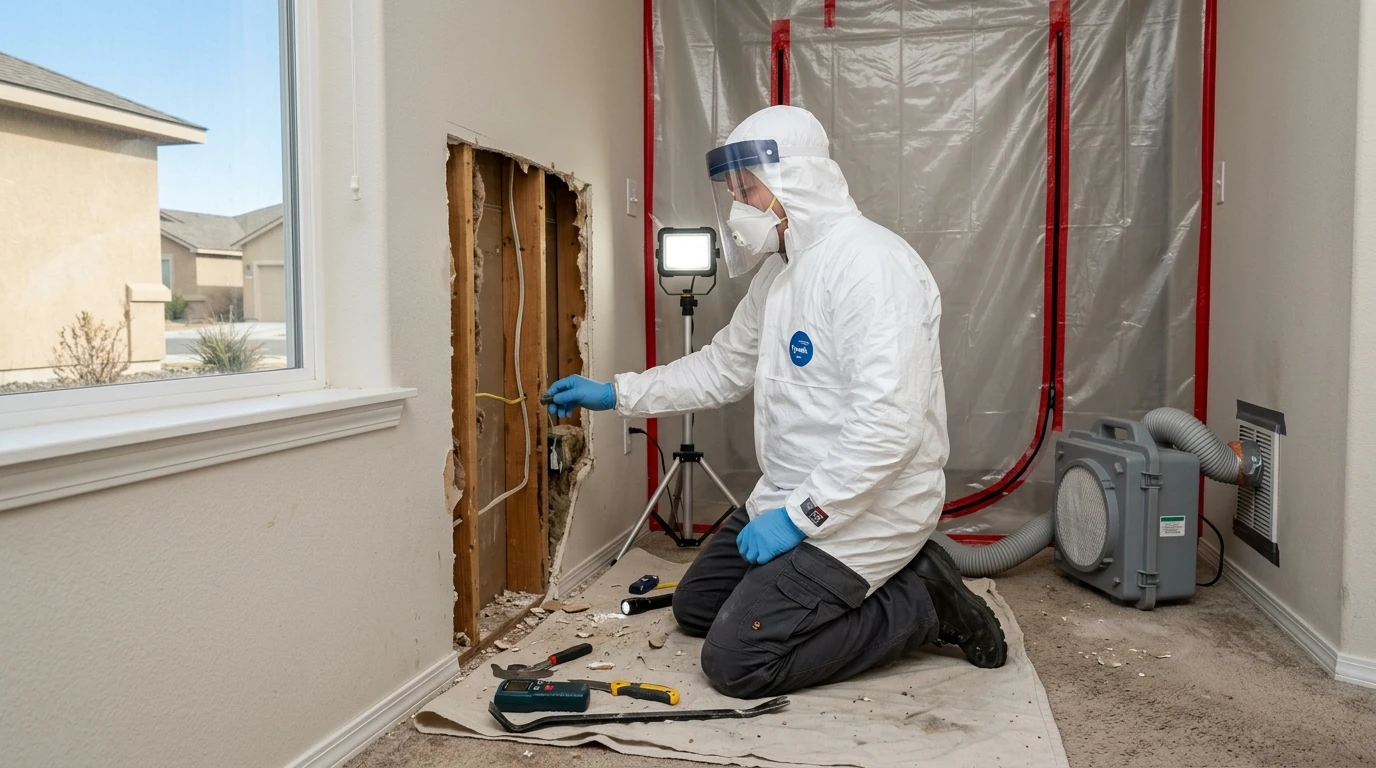
TL;DR: If a leak in your Pasco home dried out but you still smell must, or you’ve found fuzzy growth on drywall or baseboards, call a restoration company that holds both water and mold certifications (IICRC WRT and AMRT) so one crew handles the moisture check and the remediation. Mold can start within 24 to 48 hours on wet material, so don’t wait on a second opinion before containment starts.
If a leak dried faster than expected but the hall closet still smells like a damp basement, or you pulled up a baseboard in a Road 68 rental and found gray-green fuzz on the drywall, call Restoration Resource at (509) 528-1166. The company holds IICRC AMRT mold certification on top of its water-damage credentials, so the same call covers a moisture check and a mold scope, and the line answers 24/7.
Do you need a restoration company or a plumber first?
Call a plumber first only if water is still actively running, a supply line is still spraying, or a fixture is still overflowing. Shut the water off at the source if you can reach the valve safely.
Once the water is stopped, the job shifts to drying and, if mold has already started, remediation. That’s a restoration company’s work, not a plumber’s. A Tri-Cities plumber can fix a cracked line under a West Pasco kitchen sink in an hour, but they don’t run air movers, map moisture with a meter, or remove and treat mold-affected drywall under IICRC S520. If the leak happened weeks ago near Chiawana Park and you’re only now noticing the smell, you likely don’t need the plumber at all, just the restoration call.
How soon can mold start after a leak, and does a musty smell mean it’s already growing?
Mold can begin growing on wet drywall, baseboard, or subfloor within 24 to 48 hours, according to the EPA, so a leak that sat even a day or two before drying started is a real risk, not a precaution.
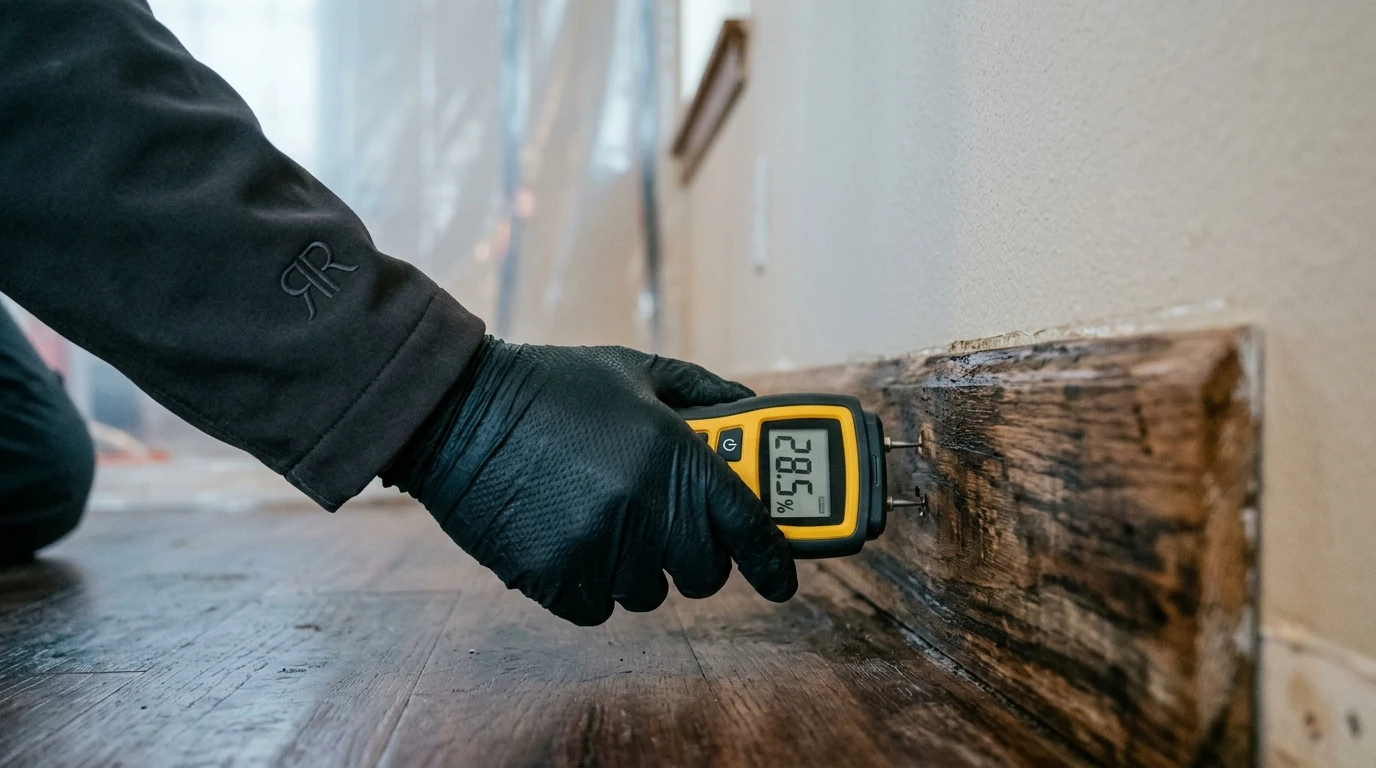
A lingering musty smell after a leak was “cleaned up” almost always means moisture is still trapped somewhere a wet-vac and a box fan couldn’t reach, commonly inside wall cavities, under baseboard, or beneath flooring. Surface drying isn’t the same as structural drying. If the smell is still there a week after the water stopped, something underneath is still wet.
Water damage company vs. mold remediation company: one call or two?
One call is usually better when the same company holds both certifications, because the handoff between “drying” and “mold removal” is exactly where jobs go wrong. A water crew that leaves without checking for growth, followed weeks later by a separate mold company starting from scratch, means two scopes, two invoices, and a gap where nobody owned the moisture reading.
Under the IICRC S520 standard, mold remediation follows a set sequence: contain the area with poly sheeting and negative air pressure, remove affected porous materials that can’t be cleaned, HEPA-vacuum and treat the remaining surfaces, then verify the area is dry and clean before containment comes down. A technician who already did the water-damage scope on the same house can move straight into that sequence instead of re-inspecting from zero.
When is mold testing worth it, and when is it a waste of money?
Testing earns its cost when there’s no visible growth but a persistent smell, a health concern, or a real-estate transaction that needs documentation. An air sample or swab from a certified inspector gives you a number to act on when you can’t see the problem.
Testing is usually unnecessary when mold is already visible on drywall or framing. At that point you know what it is and where it is; a lab report won’t change the remediation plan, it just delays the work by a few days while samples get processed. If you want a deeper walkthrough on what to look for before it gets visible, see our guide to signs of hidden mold and our notes on DIY test kits versus a pro inspection.
Will insurance cover mold from the water damage?
Mold coverage usually depends on whether the water damage itself was covered. A standard homeowners policy typically pays for mold that resulted from a sudden, accidental event, like a burst supply line or a failed appliance hose, provided you acted promptly once it was discovered, per the Insurance Information Institute.
Mold tied to a long-term leak, a slow roof seep, or anything described as gradual seepage is usually excluded, and most policies cap mold coverage even when it is included. A sewer backup or a failed sump pump needs a separate water-backup endorsement; it is not automatically part of a standard policy. Keep the moisture readings and photos from the day the leak was found, that documentation is what supports the claim.
What happens when you call
Expect a few questions about when the water appeared, whether it’s still wet, and what you can see or smell now. A technician comes out with a moisture meter and, where growth is visible, containment materials staged in the truck, so the assessment and the start of containment can happen on the same visit if the scope is clear.
For the water-damage side of the job, our water damage restoration page covers extraction and structural drying. For the mold side, our mold remediation page and mold inspection and testing page cover containment, removal, and clearance testing. If you’re not sure which you need yet, send us the details and we’ll tell you honestly.
If the water’s already stopped and you’re staring at a musty-smelling closet, the next move is a moisture check, not a guess. Request an assessment and get an answer before the growth spreads further into the wall cavity.
About Restoration Resource
Restoration Resource is an IICRC Certified Firm serving Pasco, WA and the Tri-Cities since 2022 (license RESTORL764CE), holding IICRC credentials in water damage, structural drying, mold remediation, and fire and smoke restoration. The crew handles water, mold, fire, smoke, storm, and sewage cleanup across Pasco, Kennewick, Richland, and the surrounding region, and answers calls 24/7.