
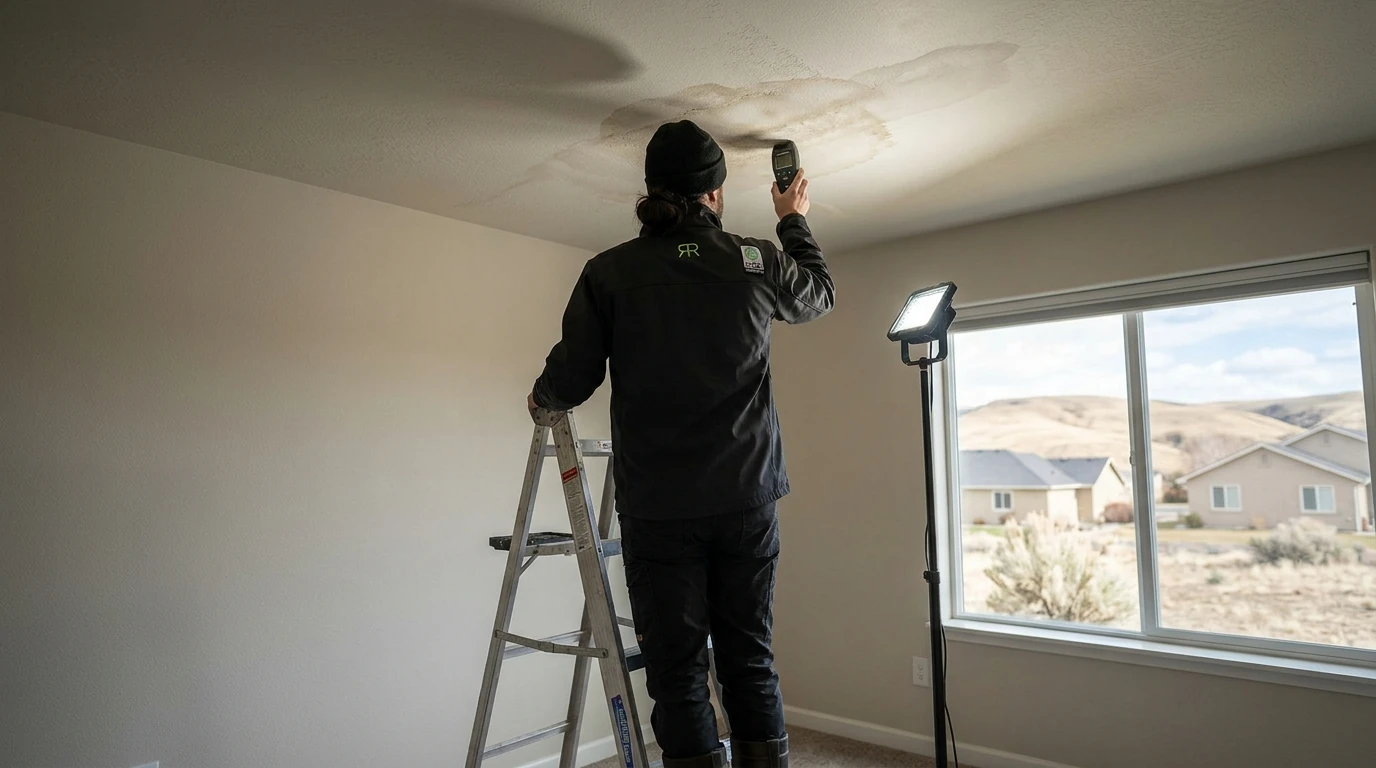
For a frozen pipe burst in the ceiling in Pasco, call Restoration Resource at (509) 528-1166. The company answers 24/7, holds IICRC certification in water damage restoration and structural drying, and carries a 5.0 Google rating across 43 reviews from Tri-Cities homeowners who have been through the exact thing you’re dealing with right now.
A pipe in a ceiling cavity or attic usually fails the same way: a hard overnight freeze along the Columbia Plateau catches a line that runs through an unheated attic space or an exterior-wall chase, ice expands inside it, and the pipe splits. You don’t find out until the thaw starts and water shows up as a stain, a drip, or a sagging patch of drywall over your head. Before you call anyone, there are two things worth 60 seconds of your attention.
Is this a “get out of the room” situation?
Yes, if the ceiling is sagging, bulging, or dripping steadily: leave that room and keep everyone out from under it. A ceiling holding standing water can fail without warning, and wet drywall plus the insulation and water sitting above it can weigh far more than the ceiling was built to carry.
Watch for a few specific signs. A brown or spreading stain is early-stage and usually not an immediate collapse risk. A visible bulge, a soft spot you can push with a broom handle, or water actively dripping in a steady stream means the ceiling material is saturated and losing its structural integrity. Treat any of those as a reason to clear the room, not just the exact spot under the leak.
If water is dripping near or into a ceiling light fixture, recessed can light, or ceiling fan, that’s an electrical hazard before it’s anything else. Shut off power to that circuit at the breaker panel if you can safely reach it without standing in water. If you’re not sure which breaker, shut off the main. Don’t touch a wet switch plate or fixture, and don’t try to catch drips in a bucket directly under a fixture.
Who do you call first: a plumber or a restoration company?
Call a plumber first only if water is still actively flowing and you couldn’t find or reach the shutoff. Once the water source is stopped, the restoration company is the next and more important call, because everything after that point is a race against time and moisture.
Most frozen-pipe bursts start as Category 1 water, meaning it came from a clean supply line, under the IICRC S500 standard for water damage restoration. That water doesn’t stay clean for long once it’s sitting in ceiling insulation, soaking drywall paper, and running down into wall cavities. The longer it sits, the more it behaves like contaminated water and the more material has to come out instead of just drying in place.
If you already have a plumber en route and the leak is contained, you can call Restoration Resource at the same time. Most ceiling-leak calls here don’t need two separate dispatches; the crew can coordinate the shutoff confirmation and start moisture mapping before the drywall has a chance to wick water any further into the structure.
What happens when you call
The first call is a short conversation to understand where the water is, whether it’s still moving, and whether anyone needs to stay out of a room. Have the water main’s location in mind if you know it, and mention the light-fixture situation if there is one, since that changes what the crew does first on arrival.
On site, the crew confirms the water is fully stopped, checks for live electrical hazards near the wet ceiling, and starts moisture mapping: using a moisture meter to map exactly how far the water traveled, both across the ceiling and down into the walls and floor below. That map decides what gets dried in place and what gets cut out, and it becomes the documentation that supports an insurance claim later.
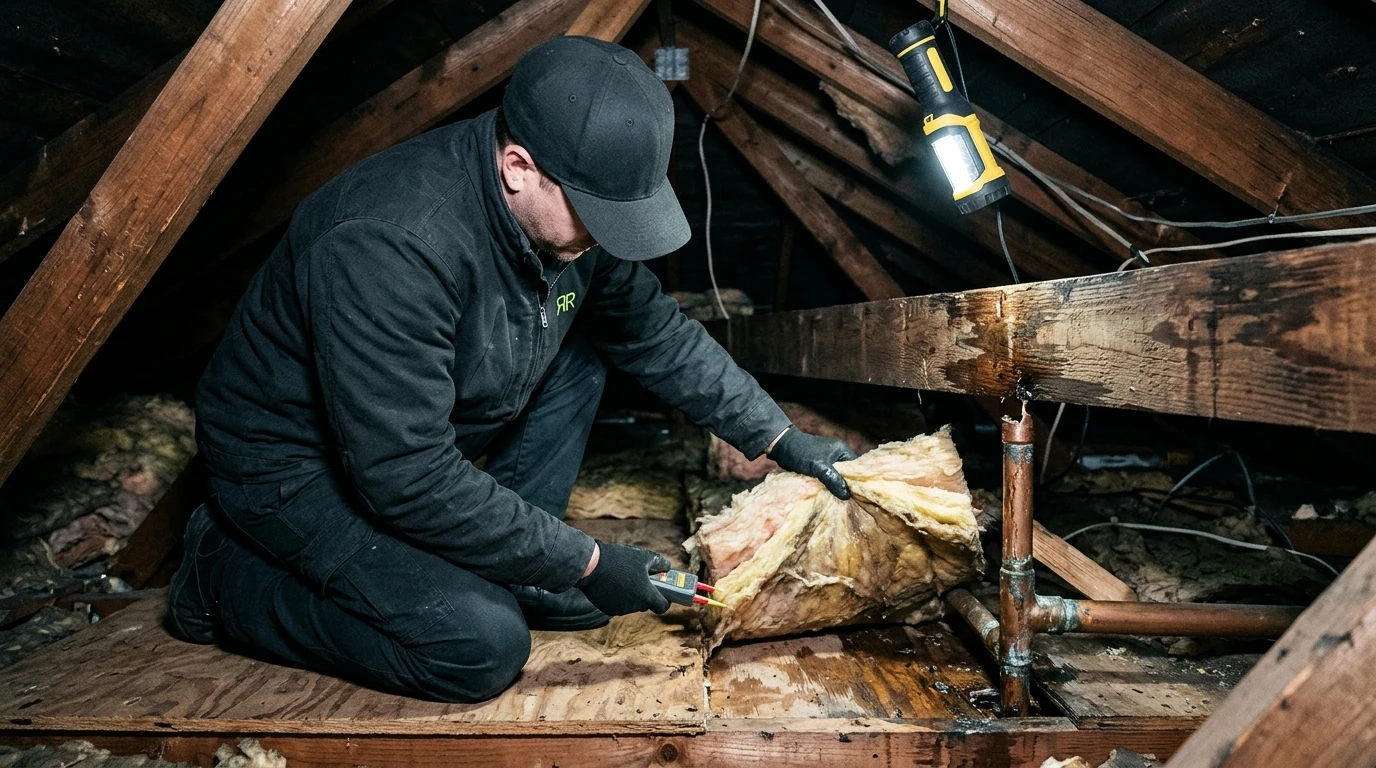
Once the extent is known, extraction and drying equipment goes in: air movers positioned to pull moisture out of the ceiling cavity, and a dehumidifier sized to the affected rooms. If the burst happened in the attic rather than directly in a finished ceiling, the approach is similar but access is different. Our burst pipe repair crews pull back attic insulation around the break first, since wet insulation holds water against the roof deck and ceiling joists far longer than open framing does, which slows drying and raises the odds that material will need to be removed instead of dried.
Will the ceiling have to come down?
Often a section does, but not the whole ceiling. Drywall that’s still structurally sound and only lightly wet can sometimes be dried in place with air movers and a dehumidifier running for several days. Drywall that’s sagging, delaminating, or has been wet for more than about 24 to 48 hours usually gets cut out, because saturated paper-faced drywall doesn’t regain its strength once it dries and it’s also where mold growth can begin, per the EPA’s guidance on mold and moisture.
Insulation above the ceiling is judged the same way: fiberglass batt that got wet is almost always replaced rather than dried, because wet insulation loses R-value and stays damp against the drywall far longer than it looks like it would. The floor below the leak gets checked too. Water that ran down inside a wall doesn’t always announce itself on the floor below right away, which is why the moisture mapping step covers that room as well, not just the ceiling itself.
If the drying plan turns up elevated moisture in framing that doesn’t come down within a few days, or if the leak sat for more than a day or two before it was caught, a mold risk assessment is worth adding before the ceiling gets closed back up. Mold remediation crews can confirm the cavity is dry and clean before new drywall goes in, which is cheaper than opening the ceiling a second time.
If you’re dealing with a burst somewhere other than directly overhead, like a slab leak or a flooded crawl space, the general frozen pipe burst in Pasco guide and the burst pipe emergency checklist cover the call order for those situations. For the ceiling scenario specifically, a documented water damage restoration scope with a written moisture map is what protects your insurance claim and keeps the repair from costing more than it needs to. Schedule an assessment through restorationresource365.com/contact once the water is shut off and the room is safe.
Restoration Resource has served Pasco, Kennewick, and Richland since 2022 as an IICRC Certified Firm, and the same crew that stops the moisture mapping and drying also coordinates the insurance documentation, so you’re not managing two companies during an already stressful week.