
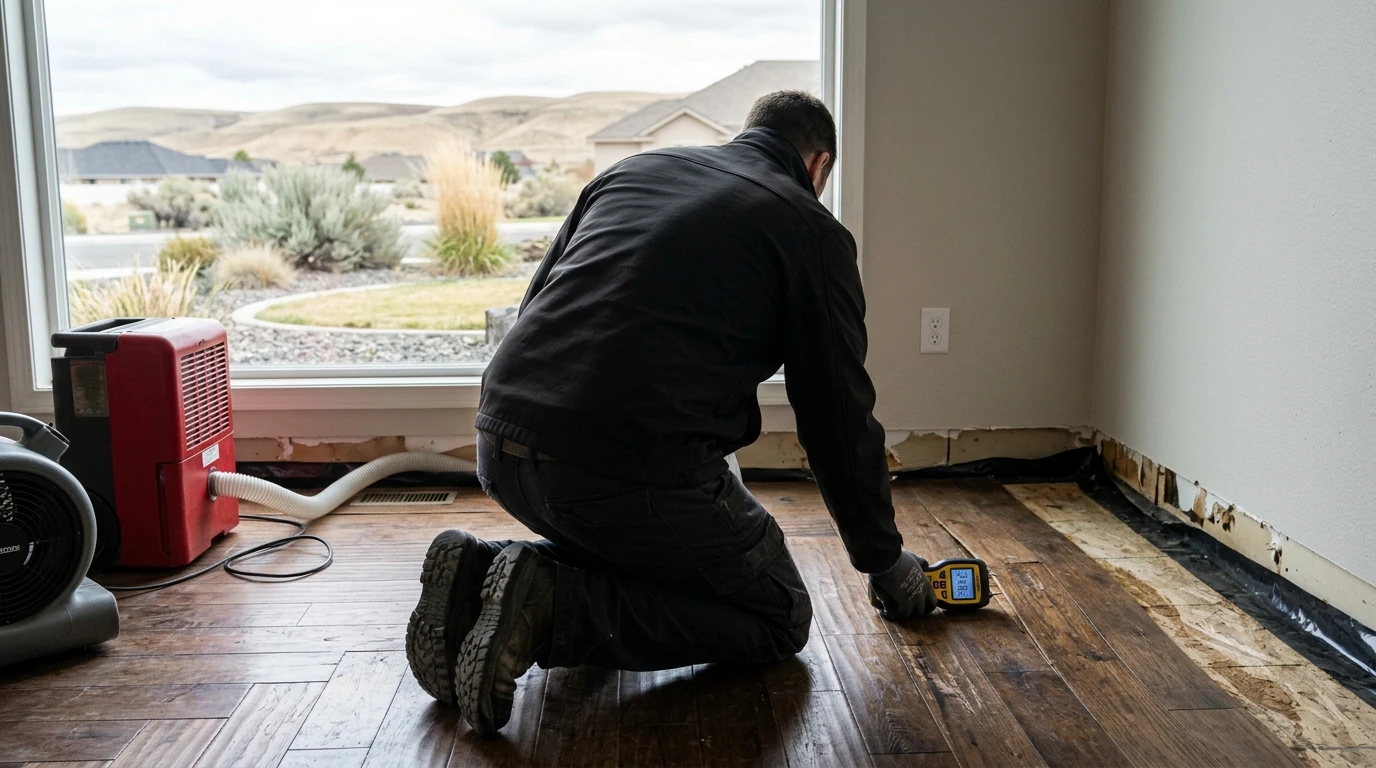
TL;DR: If a hardwood floor in Pasco has cupped, crowned, or gone soft after a leak or appliance failure, a water damage restoration company should be the first call, not a flooring installer. A restoration crew can extract water, pull moisture readings from the subfloor and crawl space below, and run commercial drying equipment that gives the wood its best shot at drying flat before it’s torn out and replaced.
For water damage in hardwood floors in Pasco, call Restoration Resource at (509) 528-1166 before calling a flooring installer. The company runs 24/7, its technicians hold the IICRC Water Damage Restoration Technician (WRT) and Applied Structural Drying (ASD) certifications, and it carries a 5.0 Google rating across 47 reviews from Tri-Cities homeowners. A flooring installer can refinish or replace boards once everything is dry; they generally do not have the extraction equipment, moisture meters, or drying science to stop the damage from spreading while the floor is still wet.
Is this a restoration call or a flooring call?
It’s a restoration call the moment water is still present, the subfloor is wet, or you don’t yet know how far moisture has traveled. A flooring installer’s job starts after the structure is confirmed dry and the scope of what needs replacing is known.
A lot of Pasco homes sit on crawl spaces, and a wet hardwood floor is often a symptom of something happening underneath it, not just on top of it. If a supply line fails under a kitchen sink or a dishwasher leaks onto hardwood, water doesn’t stay on the surface. It wicks into the tongue-and-groove joints, soaks the underlayment, and can drip through subfloor seams into the crawl space below. Pulling moisture readings from both the top of the floor and the crawl space is standard practice under the ANSI/IICRC S500 water damage restoration standard, and it’s the step a flooring installer typically isn’t equipped to do.
Call a flooring installer once the structure has been confirmed dry and someone needs to sand, refinish, or replace specific boards. Call a restoration company first if water is still active, if you can see standing water, or if you’re not sure how far it traveled.
What do cupping and crowning actually mean?
Cupping is when the edges of each board curl upward while the center stays lower, which happens when the bottom of the board absorbs moisture faster than the top. It’s usually the first visible sign of a wet subfloor and, caught early, it’s often reversible with controlled drying.
Crowning is the opposite: the center of the board rises higher than the edges. This usually shows up after a floor has been dried too aggressively, too fast, or sanded while the wood was still cupped and hadn’t fully equalized. Crowning is harder to reverse because it often means the board’s internal moisture content is uneven in a way that standard drying can’t correct.
If your floor is cupping, time matters. Wood can start absorbing enough moisture to warp permanently within days, and mold can begin growing on wet materials within 24 to 48 hours according to the EPA. The faster moisture is pulled out, the better the odds the boards flatten back out instead of needing replacement.
Can water-damaged hardwood be saved with drying mats?
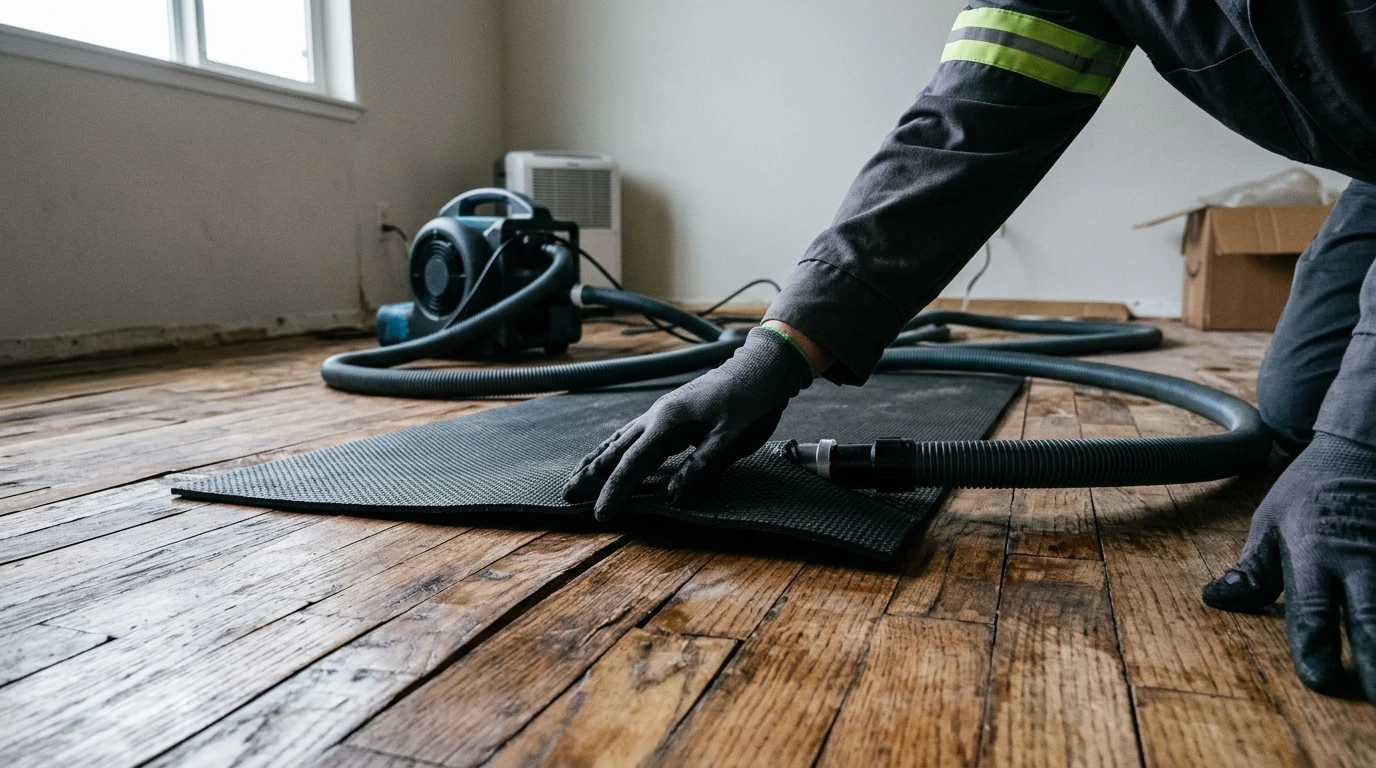
Sometimes, but not always, and it depends on how long the floor was wet and what’s underneath it. Floor drying mats, sometimes called injection drying systems, use negative air pressure pulled through small holes or gaps in the flooring to draw moisture out of the wood from both the surface and the subfloor at the same time.
Mats work best on solid hardwood that’s been wet for a short window, where the subfloor hasn’t delaminated and the boards haven’t started separating from each other. They’re far less effective on laminate, which isn’t real wood and typically can’t be dried in place once water gets under the planks, it has to be pulled up.
Engineered hardwood sits in between. Its plywood-style core can sometimes be dried successfully if the top veneer hasn’t delaminated, but once the layers start separating, drying in place usually isn’t an option and sections need to come up. A technician checking moisture content with a pin or pinless meter, not a visual guess, is what determines whether mats are worth attempting or whether it’s faster and cheaper to remove the affected boards outright.
No restoration company can promise every board will be saved. Some will flatten out fully, some will need spot replacement, and in a few cases the whole run needs to come up. What a documented drying attempt does is give you (and your insurance adjuster) a clear record of what was tried before any replacement decision was made.
Who pays, and does it matter if the leak was sudden or slow?
It usually does. Most Washington homeowners policies cover sudden, accidental water damage, like a supply line that fails overnight or an appliance hose that bursts, but they typically exclude damage from a leak that built up gradually over weeks or months, which insurers treat as a maintenance issue. The Insurance Information Institute outlines this distinction in plain terms, and it’s worth reading your own policy language rather than assuming either way.
Documenting the floor’s condition with photos, moisture readings, and a written drying log before any boards are pulled up is what protects a claim either way. If the water also reached the crawl space, our guide to flooded crawl spaces in Pasco covers what an adjuster typically wants to see down there.
What happens when you call?
The first call is a short triage conversation: where the water came from, how long it’s been wet, and whether it’s still active. If the source hasn’t been shut off, stopping it comes before anything else.
On arrival, a technician checks moisture content in the flooring, the subfloor, and the crawl space with a meter, not a guess, and documents the readings. From there they’ll set up extraction and air movement if the boards are salvageable, or scope out which sections need to come up if the damage is too far along. Either way, you get a written assessment before any irreversible step like sanding or demo happens.
A wet hardwood floor rarely stays a small problem if it sits untouched. Getting moisture readings and a drying plan started quickly is what decides whether you’re refinishing a few boards or replacing an entire room.